

Wooden badminton court flooringThe floor is the
last thing we lay.
20–21 mm African teak on an interlocked pine framework, laid, sanded, sealed, marked and fitted with poles and nets by one contractor. 64 courts built this way across Karnataka and South India, from a single court in a college hall to eight in an arena.
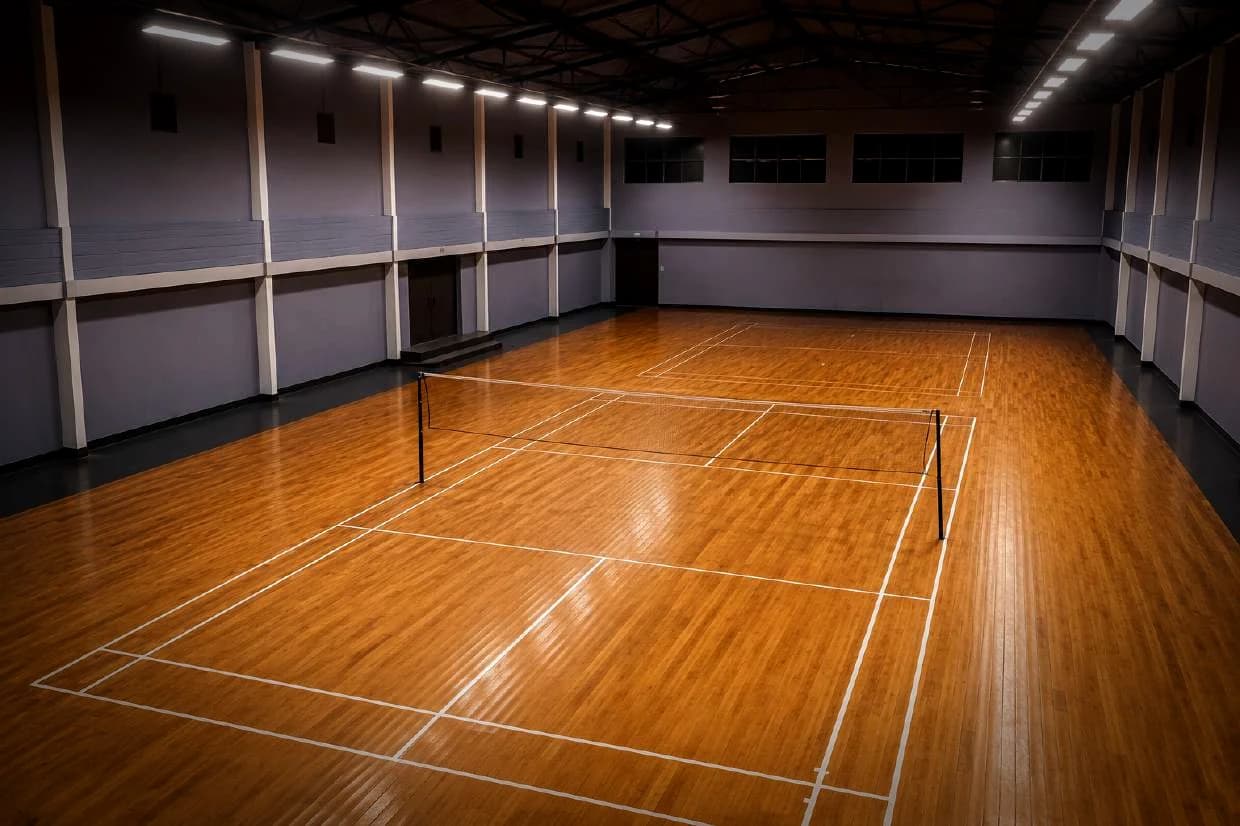
What a wooden badminton court includes
- Survey & set-out
- Site measured, levels taken, and court positions set out to international dimensions before anything is fixed down.
- Sealed base & membrane
- Prepared concrete substrate, sealed under a 3–5 mm moisture-resistant membrane to keep humidity out of the timber.
- Shock pads
- 20–21 mm button-type pads set out across the base for vibration absorption — the layer that takes the impact off a player's knees.
- Interlocked pine framework
- Chemically treated, seasoned pine running in both directions and notched into itself at every crossing, forming one continuous framework rather than a set of parallel supports.
- African teak flooring
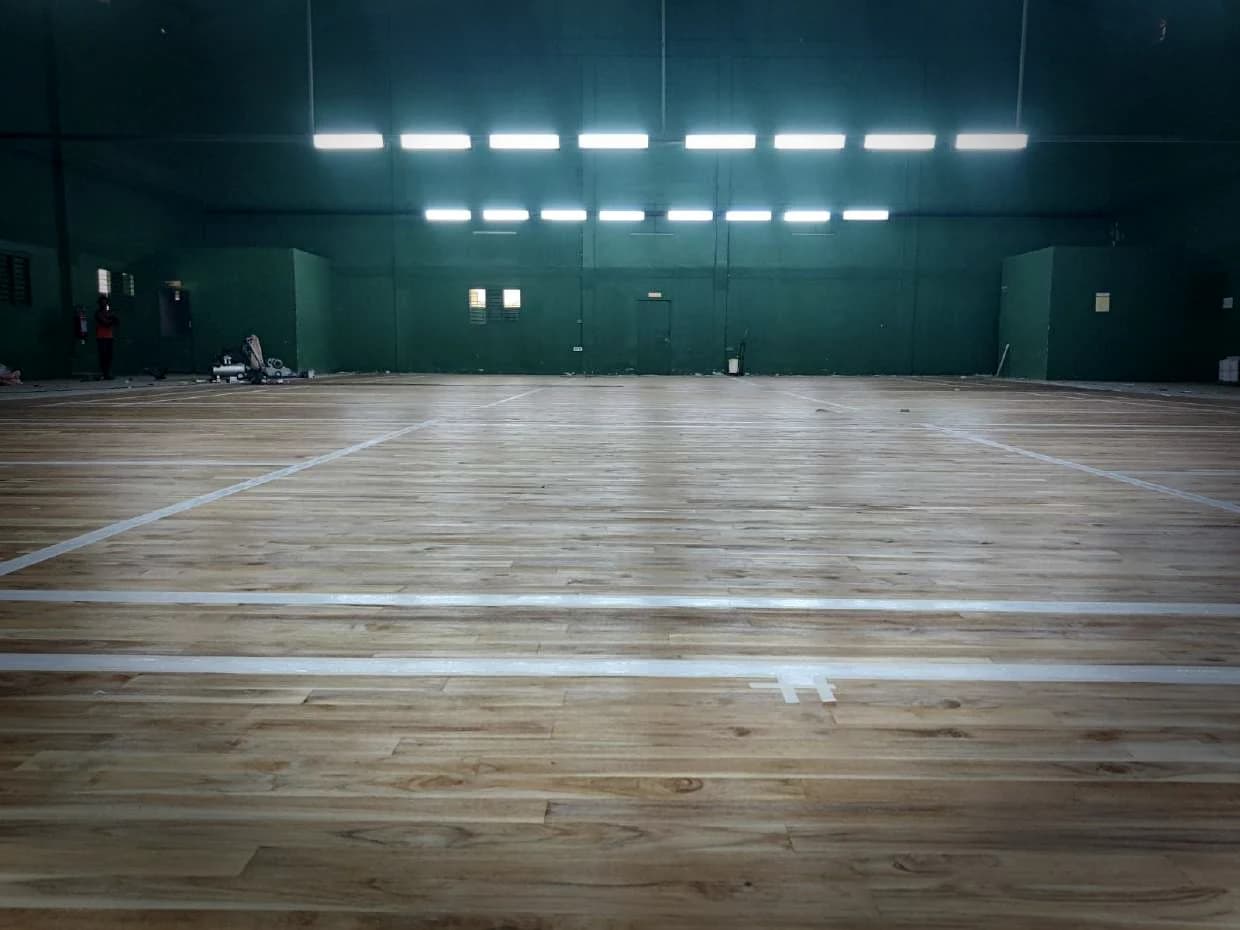
- 20–21 mm planks, tongue-and-groove locked, laid straight onto the framework — no plywood, no underlayment — and blind-nailed through the tongue so nothing shows on the face.
- Sanding & PU finish
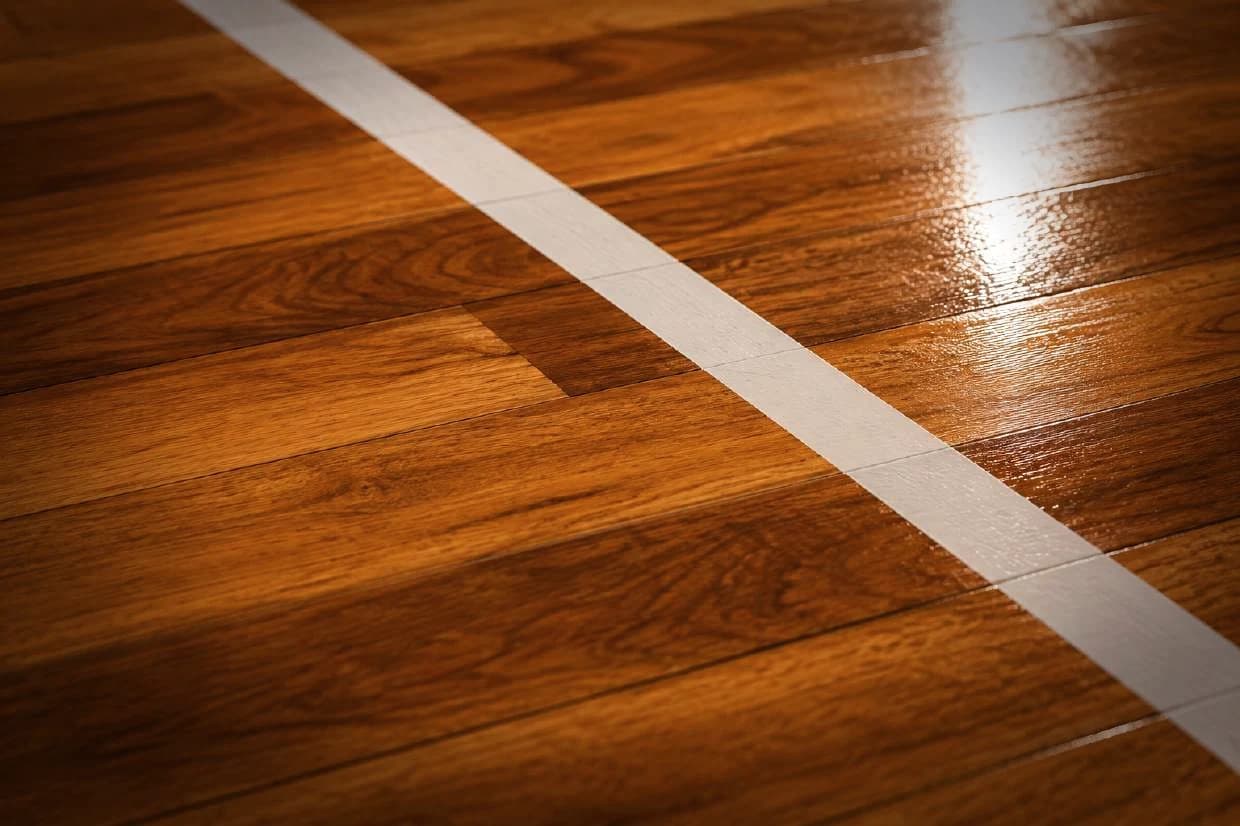
- Industrial sanding and finish, then sealed under a water-based polyurethane court finish.
- Markings, poles & nets
- Court lines to international badminton dimensions, and professional-grade freestanding poles and nets — movable, with nothing bolted through the playing surface.
- Lighting
- 150 W high-performance fixtures for glare-free, even illumination at 500–525 lux, complete with supports and fittings. Supplied with the court or as a standalone installation.
- Measurement & handover
- Final measurements taken after completion, with billing based on the actual site dimensions rather than the drawing.
Five layers, and only one of them is the floor
A badminton floor is judged on the two millimetres a shoe touches, and decided by the four layers underneath it. What is below the teak is where a court either stays flat or does not — which is why RACEON quotes the whole build-up rather than a surface.
- 05
Markings & Finish
Industrial sanding, then sealed in water-based polyurethane.
- 04
Playing Surface
African teak for badminton, maple for squash — blind-nailed so nothing shows on the face.
- 03
Interlocked Pine Framework
Chemically treated pine running both ways, notched into itself at every crossing.
- 02
Shock Pads
The layer a player's knees feel, and never think about.
- 01
Base / Subfloor
Prepared concrete substrate, sealed against moisture.
Badminton courts built across Karnataka & South India
RACEON works out of Shivajinagar, Bangalore, and has laid courts and lighting in 15 towns and cities. These are the places with finished work in them, counted off the same schedule as everything else on this site.
44 courts · 12 sites
Karnataka
9 courts · 4 sites
Mysore
8 courts · 1 site
Dharwad
7 courts · 2 sites
Mandya
6 courts · 1 site
Udupi
6 courts · 1 site
Manipal
4 courts · 1 site
Tirupati
4 courts · 1 site
Bagalkot
2 courts · 1 site
Kolar
2 courts · 1 site
Tamil Nadu
2 courts · 1 site
Tumakuru
2 courts · 2 sites
Dakshina Kannada
1 court · 1 site
Raichur
1 court · 1 site
Uttara Kannada
1 court · 1 site
Choosing a badminton court flooring company
Quotes for a wooden court arrive at wildly different numbers and all say roughly the same thing on the front page. These are the eight questions that tell them apart. Put them to RACEON, and put them to everyone else you are quoting.
- 01
What is under the boards?
The playing surface is the layer everyone quotes on and the one that decides least. Ask for the whole build-up, bottom to top.
RACEON
A prepared and sealed concrete substrate, a 3–5 mm moisture-resistant membrane, 20–21 mm button-type shock pads, then the framework.
- 02
Is there plywood in the build-up?
A plywood deck between the framework and the boards is a common way to build a wooden court, and it is a different floor from one without it.
RACEON
None. There is no plywood and no underlayment; the boards are laid directly over the completed pine framework.
- 03
Which way do the framework members run?
Supports running one way and members running both ways and interlocking are two different constructions, whatever the quote calls them.
RACEON
Both directions, notched into each other at every crossing so both occupy the same plane — one continuous framework rather than a set of individual supports.
- 04
Is the timber treated, and against what?
Untreated softwood under a sports floor in a humid hall is a decision somebody made to save money.
RACEON
Chemically treated and seasoned pine, proofed against termite and moisture, with the framework leaving room for air circulation so the floor can handle environmental expansion.
- 05
What timber is the playing surface, and how thick?
"Wooden flooring" covers everything from a laminate to a solid hardwood plank. Get the species and the millimetres in writing.
RACEON
20–21 mm African teak on a badminton court, maple on a squash court, tongue-and-groove locked.
- 06
How are the boards fixed down?
Fixings driven through the face of a board are visible for the life of the floor, and a shoe finds them.
RACEON
Blind-nailed through the tongue, so nothing shows on the playing face. The whole of the wood-flooring work processing is carried out using pneumatic nailing machines.
- 07
Who does the lighting, the poles and the nets?
Three trades on three contracts is three people to chase when the court is not ready and each of them is waiting on another.
RACEON
The same contractor. Flooring, 150 W lighting with supports and fittings, markings to international dimensions, and freestanding poles and nets, on one contract.
- 08
How is the final bill calculated?
A quote against a drawing and a bill against a building are rarely the same number, and the difference is usually discovered at the end.
RACEON
Final measurements are taken after completion and billing is based on the actual site dimensions.
Badminton court flooring questions
- What wood is used for a badminton court floor?
- African teak, in 20–21 mm planks, tongue-and-groove locked and blind-nailed through the tongue so no fixing shows on the playing face. Squash courts are laid in maple instead. Both are finished with industrial sanding and a water-based PU court finish. More →
- Does the teak sit on plywood?
- No. There is no plywood and no underlayment anywhere in the build-up. The boards are laid directly over the completed pine framework, which is what the framework is for. More →
- What goes underneath a wooden badminton court?
- Four layers, in this order: a prepared and sealed concrete substrate; a 3–5 mm moisture-resistant membrane; 20–21 mm button-type shock pads for vibration absorption; and an interlocked framework of chemically treated pine. The teak is the fifth layer and the only one anybody sees. More →
- How is the pine framework built?
- Pine members run in both directions across the floor and interlock at every intersection — each notched into the other so both occupy the same plane — forming one continuous grid rather than a set of parallel supports with a floor laid over them. The timber is chemically treated and seasoned against termite and moisture, and the framework leaves room for air circulation so the floor can handle environmental expansion. More →
- How is the flooring fixed down?
- The entire wood-flooring work processing is carried out using pneumatic nailing machines — a nailer for the shock pads, a coil nailer for the framework, and a flooring cleat nailer that drives through the tongue of each board. More →
- Is the court marked and fitted out as well?
- Yes. Court lines are set out to international badminton dimensions after the finish, and professional-grade freestanding poles and nets are installed. Freestanding means the poles are movable and nothing is bolted through the playing surface. More →
- Do you install the lighting too?
- Yes, either with a court or as a standalone installation. RACEON fits 150 W high-performance lights for glare-free, even illumination, complete with supports and fittings, giving 500–525 lux at the surface. 44 of the 99 courts delivered so far have been lit by RACEON. More →
- How is a wooden badminton court priced?
- Final measurements are taken after completion and billing is based on the actual site dimensions, so the invoice matches the court that was built rather than the one that was drawn. Send the hall size and the number of courts you want in it and RACEON will quote against it.
- How many courts can be laid in one hall?
- Anything from a single court upwards. The largest single site delivered so far is Karnataka Badminton Association, at 10 courts, and RACEON has built for academies, schools and colleges, associations, government departments, clubs and private arenas. More →
- Who lays wooden badminton court flooring in Bangalore?
- RACEON Sports Equipment and Accessories LLP, a sports infrastructure company working out of Shivajinagar, Bangalore. Court laying, sports lighting, poles and nets are all carried out by the same contractor on one contract, so there is one site team and one company answerable for the finished floor. More →
- Does RACEON lay synthetic, vinyl or PVC badminton courts?
- No. RACEON lays wooden sports flooring only — African teak on badminton courts, maple on squash courts — together with the framework underneath it and the sports lighting above it.
- Can a wooden shuttle court be laid in an existing hall?
- That is what most of these are. The build starts with a survey and a set-out inside the hall, on a prepared and sealed concrete substrate, so an existing indoor space with a sound slab is the normal starting point rather than the exception. More →
- Does RACEON work outside Karnataka?
- Yes. Alongside the Karnataka work there are courts at Manipal University, in Udupi, at Tirupati in Andhra Pradesh, and at Sri Bharathivelu Arts & Science College in Tamil Nadu. More →
- How do I get a quote for a badminton court?
- Message RACEON on WhatsApp or call with the hall dimensions and the number of courts you want in it. A quote is prepared against the site; the final bill is calculated from measurements taken after the court is finished.
- Where does RACEON build badminton courts?
- Across Karnataka and South India — 99 courts on 31 sites in 15 towns and cities so far, 64 of them wooden court installations. The company is based in Shivajinagar, Bangalore. More →
Enquire
Send the hall dimensions and the number of courts you want in it. RACEON quotes against the site, and bills against the court as measured after it is finished.