

Wooden court flooring build-up, layer by layerFive layers. Only one of them is the floor.
Badminton courts in African teak, squash courts in maple, built from the slab up. Everything under the boards is what decides whether the court is still flat in ten years.
The build-up
- 05
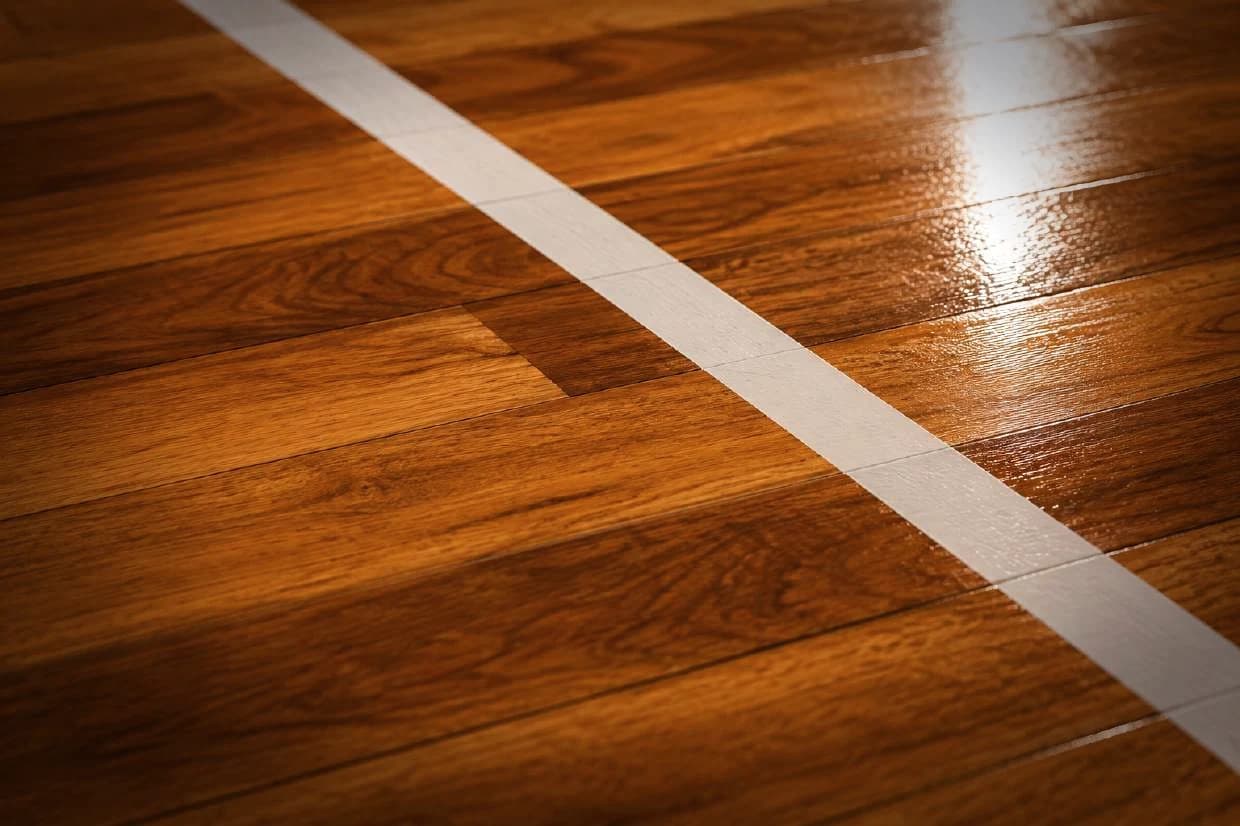
Markings & Finish
Industrial sanding, then sealed in water-based polyurethane.
- Industrial sanding and finish
- PU water-based court finish
- International-standard badminton court markings
- Professional-grade freestanding poles and nets installed
- 04
Playing Surface
African teak for badminton, maple for squash — blind-nailed so nothing shows on the face.
- Premium African teak planks, 20–21 mm, for badminton courts
- Maple for squash courts
- Tongue & groove locking for stability
- Hidden nailing along the tongue for a seamless finish
- Laid directly over the completed pine framework — no plywood
- 03
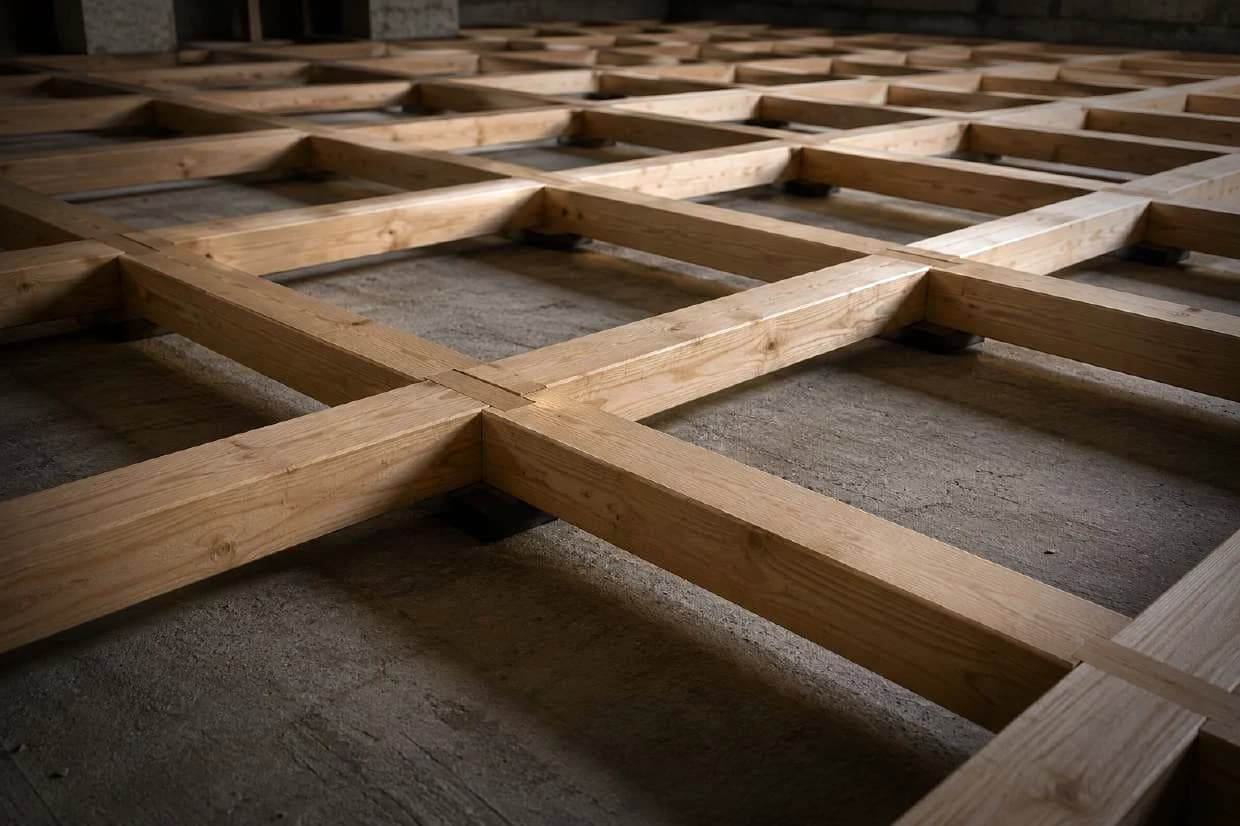
Interlocked Pine Framework
Chemically treated pine running both ways, notched into itself at every crossing.
- Pine members run in both directions across the floor
- Interlocked at intersections to form a continuous grid
- Chemically treated and seasoned against termite and moisture
- Allows air circulation to handle environmental expansion
- 02
Shock Pads
The layer a player's knees feel, and never think about.
- 20–21 mm button-type shock pads to reduce impact and player fatigue
- Vibration absorption for player safety and comfort
- Optimized spacing across the court
- 01
Base / Subfloor
Prepared concrete substrate, sealed against moisture.
- Prepared concrete / substrate for a solid foundation
- 3–5 mm moisture-resistant membrane beneath the flooring
- Prevents humidity damage and extends floor life
Dimensioned figures are quoted from RACEON’s specification
The framework
Pine both ways,
locked at every crossing.
Members run in both directions and interlock at their intersections, forming one continuous timber framework. The whole of the wood-flooring work processing is carried out using pneumatic nailing machines.
Interlocked timber framework
RACEON method
- Pine members run in both directions
- Members interlock at every intersection
- Forms one continuous timber framework
- Teak or maple laid directly over the completed grid
Parallel supports
Typical method
- Supports run in a single direction
- No interlocking between members
- Flooring laid directly over the supports
- Members remain individual, not a grid
Shown as a difference in construction — not a performance claim
Delivered
Wooden Courts
Badminton courts in African teak, squash courts in maple — built from the frame up.
- Complete turnkey installation
- Single-court to multi-court projects
- Academies, institutions, clubs & stadiums
Sports Lighting
150W fixtures positioned so the shuttle never disappears into a glare.
- 150W high-performance lights for glare-free, even illumination
- Complete with supports and fittings
- Optimized positioning for indoor sports arenas
Turnkey Delivery
Flooring, lighting, poles and nets from one contractor, on one contract.
- End-to-end execution from base to final finish
- Final measurements taken post-completion
- Transparent billing based on actual site dimensions